Showing posts with label Tribal Disenrollment. Show all posts

Monday, January 5, 2026

Federal Inaction To Civil and Human Rights Abuses of TRIBAL DISENROLLMENT Enables the Erasure of Native Citizens for Profit

Senators of the Senate Committee of Indian Affairs,

I am writing to you in your capacity as a member of the Senate Committee on Indian Affairs to demand immediate federal action regarding the widespread and ongoing abuse of tribal disenrollment. What has occurred—and continues to occur—within gaming tribes is a profound civil rights failure, enabled by federal inaction and rewarded by federal policy.  Frankly, your committee is 20 years overdue in acting to protect over 11,000 Native Americans.

I am one of thousands of Native Americans who have been forcibly removed from our tribes since the advent of Indian gaming. These removals are not coincidental.  The overwhelming majority of mass disenrollments occur in tribes operating casinos, where the motive is clear and undeniable: fewer members mean larger per capita payments for those who remain. This is not sovereignty. This is profiteering through the systematic erasure of people.

In my own tribe, known then as the Pechanga Band of LuiseƱo Mission Indians of Temecula, California, approximately 250 people—fully 25% of the tribe—were stripped of membership without due process. With that act, we lost our civil rights, our voting rights, access to healthcare, education assistance, and our lawful and rightful per capita distributions. Families were torn apart. Elders and ancestors were erased. Children were punished for something they could not possibly control.

Most disturbingly, Pechanga officials physically removed children from their school on the reservation, escorting them out and informing them they were not to return because they were “no longer Pechanga.” These were children who had grown up knowing only one identity—that they were Pechanga. The trauma inflicted by that moment cannot be overstated. Children lost their school, their friends, their community, and their sense of self overnight. 

This is not an internal administrative matter. This is abuse.


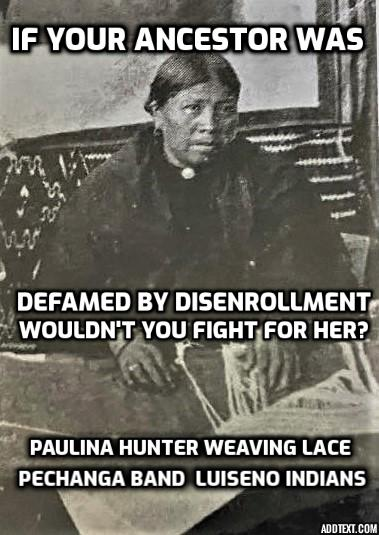
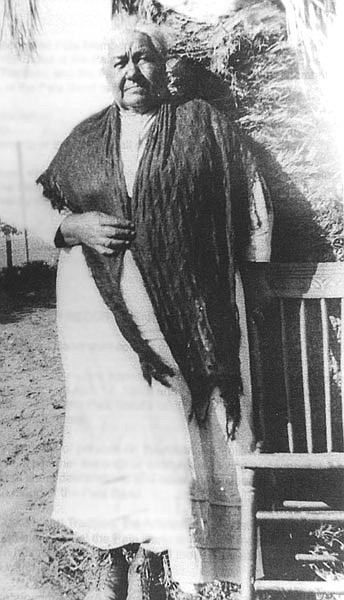
Paulina Hunter  Died 1899
Disenrolled 2006


My ancestor is Paulina Hunter. My family has always been, and remains, Pechanga. 94 adult members of my family—despite incontrovertible proof of lineage—were disenrolled.  We possess hundreds of  certified documents from both state and federal sources affirming our ancestry. Even more damning, the tribe itself hired the foremost anthropological expert in California, Dr. John Johnson, who concluded in a detailed twelve-page report that, based on the preponderance of evidence, Paulina Hunter was Pechanga. The tribe simply ignored the expert testimony it paid for.

Council members slept through hearings. Conflicts of interest—including land disputes dating back over a century—were never disclosed or addressed. Bias was blatant. Due process was nonexistent. We had no attorneys allowed and we could not confront our accusers.  Venezuelan dictator Maduro is afforded more rights

The financial incentive is equally blatant. After my family and another were removed, per capita payments rose from approximately $250,000 annually to more than $350,000 per person. Elders who lived and died as Pechanga are now posthumously declared “non-Indian” by a vote. My aunt was buried in the tribal cemetery with the assistance of the Tribal Chairman, who publicly praised her as a proud Pechanga member. Today, the tribe denies she ever belonged.

This is not an isolated case. Across the country, disenrollment has been used as a weapon. In the Cherokee Nation, 2,800 Black Cherokee Freedmen were stripped of citizenship. When public officials such as Assemblymember Diane Watson spoke out against this injustice, they were targeted for doing the right thing. That retaliation alone demonstrates how deeply entrenched—and protected—these abuses have become.  Thankfully, that case was taken up by the Cherokee Courts and the Freedmen won their treaty rights.   Because of Congress's inaction, people have lost their homes, their health and their lives.

 Let me be clear: no amount of money justifies the federal government rewarding the destruction of civil rights. Is this truly what Congress intends to endorse?

Tribal sovereignty was never meant to be a shield for human rights abuses. When sovereignty is used to disenfranchise citizens, erase families, and traumatize children for financial gain, it becomes the responsibility of the federal government to intervene.

This matter demands congressional hearings, federal oversight, and legislative reform. At minimum, it demands your attention and action. Silence is no longer defensible.


Our family, along with many others nationwide, has documented these abuses publicly at:

http://originalpechanga.com

I urge you to review the evidence and to act. The federal government has both the authority and the moral obligation to protect Native citizens from being stripped of their identity and rights for profit. Anything less is complicity.

I am formally requesting your moral leadership in investigating tribal disenrollment practices and in supporting concrete measures that protect the civil rights of all Native people.


Respectfully,


Rick CuevaS

Descendant of Paulina Hunter

Owner Original Pechanga's Blog

Thursday, December 18, 2025

The Trauma and Pain of Losing Tribal Heritage: The Devastating Consequences of Tribal Disenrollment Kept SECRET

 Disenrollment is the process of removing members from a tribe's rolls or membership, effectively stripping them of their tribal heritage and all the associated benefits that come with it.

This is an experience that can cause immense pain and heartbreak for those affected. Losing tribal heritage through disenrollment can have significant social, cultural, and economic consequences, and the impact is often felt for generations.  This is an abuse of our ancestors.


For those who have been disenrolled, the pain of losing their tribal heritage is multifaceted. They may feel a profound sense of loss and grief as they are cut off from their ancestral roots and no longer have a connection to their tribe. They may also feel a sense of betrayal, as the tribe that they believed to be their family turns its back on them.

At Pechanga, the disenrollment of my ancestor Paulina Hunter, 107 years after she died, and the same after so many years of traveling by wagon from Los Angeles, to Temecula, to be included in the censuses was a direct attack, by people who were not with the tribe at that time.   The Butch Murphy family for one.

For many Native Americans, being part of a tribe is not just a matter of ancestry or heritage. It is a vital part of their identity, providing a sense of belonging and community that is difficult to replicate elsewhere. Losing that connection can be isolating and traumatic, leaving people feeling adrift and disconnected from their cultural and social roots.  Read NATIVE HEART  written by my cousin Della.

Disenrollment can also have significant economic consequences, as those who are removed from tribal rolls lose access to tribal resources, including healthcare, education, and financial assistance. This can be particularly devastating for those who rely on these resources to survive, such as the elderly or those with disabilities.

The loss of tribal heritage through disenrollment can also have a profound impact on future generations. Children and grandchildren may be cut off from their tribal heritage and culture, leading to a loss of traditional knowledge, language, and values.  IN FACT, PECHANGA sent jack-booted thugs to pull our youth from the tribal school, see that video description here.
This can have a lasting impact on their sense of identity and their ability to connect with their community and cultural roots.

Friday, March 10, 2023

Silence is Complicity: Failure to Stand Against Tribal Disenrollment is a Betrayal of Tribal Community and Justice


SILENCE ON DISENROLLMENT IS NOT GOLDEN 

The fight against disenrollment requires courage, perseverance, and a commitment to justice and human dignity. It requires us to speak out against injustice and to stand in solidarity with those who have been disenrolled or who are at risk of disenrollment.


There are so many reasons why tribal members won't stand up against leadership when they are doing wrongs. For some, it's a sense of loyalty and misguided respect towards the leaders, who may have earned their trust and misplaced admiration over time. This loyalty can be further strengthened by deference to authority figures who professed to care about them.  

A stronger reason may be fear of retaliation or retribution. Leaders who hold significant power and influence within the community may be able to wield that power to punish or ostracize those who speak out against them. This abuse of power creates a climate of fear and silence, where people are hesitant to voice their concerns for fear of being targeted next.

Tribal politics are complex and nuanced, with various factions and interest groups vying for power and influence.  Members may feel pressure to align themselves with one group over another, and may be hesitant to speak out against their own leaders for fear of upsetting this delicate balance of power at any cost. Many have asked, "why is it so hard to do the right thing?"

Tuesday, February 7, 2023

Why YOU Should Care About the Theft of Tribal Heritage and the Crimes Against Indian People and the Results of Tribal Disenrollment

Here’s why you should care about Native American Tribal Disenrollment 

Disenrollment Chieftains, are the people who run (more properly RUIN) our culture and teach our kids tribal values. They shape the next generation’s attitudes.  They teach our native children that it's OKAY to get rid of their classmates, someone else's aunty, or grandmother.


If one persons rights are violated, any persons rights are violated. How many of our people does it does it have happen to be wrong?

Five? 50?  100?    Starting to sound bad, right?

In the case of tribal disenrollment, it's over 10,000 who have been harmed.  And that's JUST the LIVING.  Our ancestors, whom most every tribe has used in one way or another (early tribal population, land for casino, federal monies) were once proudly used to support the tribe's quest for advancement.

Thursday, February 2, 2023

Native Advocates (NARF, NCAI, ACLU, NIGA) YOU DON'T CARE About Disenrolled Native Americans ABUSED and Disenrolled by Their Tribes

All advocates talk a good game on civil rights, actions to take, protesting mascotry, but the deafening silence on tribal disenrollment stand out to over 11,000 of us, who have been stripped of our tribal rights to belong.

You aren’t a bad person for not being consumed by the tribal disenrollment, but you kind of are if you pretend to be and do nothing about it beyond hoping we acknowledge you care
                                paraphrased from the article linked below

#StopDisenrollment

An article about the UYGURS of China, an oppressed group by every standard of human decency by Derek Hunter in Townhall got me thinking of the comparisons to the disenrolled of 90 Tribal Nations which have over 11,000 Natives stripped of citizenship. Alice Langton Sloan had kept a diary of the tribes, I don't have a current update, but here's the breakdown of disenrolling tribes from 2016


Inaction speaks louder than words.  The NCAI has studiously avoided the issue for decades, here at Original Pechanga Blog, we have called them out through at least 3 Presidents (of the U.S. and the NCAI) READ those   Here  or HERE  or here   That silence and inaction favors the oppressors.  Even worse, they bring in disenrollment chieftains as honored leaders.  Any abuses of Native people are okay, just don't use a Native mascot?

John Gomez Jr. former head of the American Indian Rights and Resources Organization published 10 Things You Can Do To Help Stop the Lawlessness in Indian Country   That got some movement from politicians like Rep. Mike Thompson from N. California. He wrote to Nick Rahall then head of the House Natural Resources committee asking for oversight hearings  but this was an exception.

We've written to Attorneys General Barr,  Sessions , Eric Holder, Lynch  Governors, Senators.  Mostly to crickets, although Barbara Boxer responded with a campaign letter.

Let's circle back to our Native advocates.  We have called for boycotts of offending tribes' enterprises, each of the TOP TEN INDIAN CASINOS To AVOID because THEY CHEAT Their OWN People have violated one or all of the rights on this list:

•Stripped tribal members of their citizenship
•Denied voting rights to members
•Taken away rightful healthcare to seniors
•Blocked access to land on the reservation
•Denied members due process of law, including legal representation, even writing tools.
•Prohibition of practicing religion, including the right to pray at their ancestor's graves.
•Threatened others if they speak out
•Subjected some to ex post facto laws.

Since President Biden's Voting Rights Act is the talk of the present, be reminded that all 11,000 of us have lost the right to vote in our tribes elections. Imagine if Republicans lost 25% of the vote, giving Democrats unlimited power...or vice versa.

What can YOU DO?  Without much effort, YOU can  Stop patronizing disenrolling tribe's casinos, hotel, restaurants and their powwows. Let them know that we do not agree with their system of denying civil rights to their people and until they follow their own tribal law, you, as a proud citizen will NOT support their nation, but will patronize their competitor nations.   If you don't tell them why you aren't coming, they could just think, business is bad.  Mabuhay Radio joined in a boycott of Pechanga when the tribal council started stripping citizenship from tribal members and stealing their per capita.

I understand we can't all STAND UP FOR ALL RIGHTS ALL THE TIME, but a couple of small actions, including sharing the stories we've put here for 15 year, is a step in the right direction.  It just takes a little effort, from a lot of us.   And there is GOOD NEWS on restoration of some to their tribes:
ENTERPRISE RANCHERIA   Robinson Rancheria  The Cherokee Freedmen won their treaty rights, and the Grand Ronde followed the tribal courts decision bringing back Chief Tumulth's descendants   JUST RECENTLY, the Cahto tribe of the Laytonville Rancheria brought a long disenrolled family back.

Read here on SOMEBODY DO SOMETHING  You will see THAT somebody is in the mirror LOOKING BACK.


Sunday, December 11, 2022

Original Pechanga Blog's 4,000th Post: A Paper Genocide (Lament of the Disenrolled Indian) by Kent Appel

This is my 4,000th post since 2007 for Original Pechanga Blog, PROUD to have our cousin's song on tribal disenrollment here for you .  PLEASE click the youtube link to listen.  His words are below.


My cousin, Kent Appel, who contributes greatly to the comment section at Original Pechanga Blog, as 'AAMOKAT' , is also a songwriter and poet.  
His song on DisenrollmenNAILS IT  The words are STRONG, you can hear Kent sing it on his YOUTUBE page.


"Casino people, Shameful Tribe, Betrayed Your Own, A Paper Genocide."

A PAPER GENOCIDE (LAMENT OF THE DISENROLLED INDIAN) 
BY KENT APPEL (‘AAMOKAT)

WE WERE ONE INDIAN NATION
WHEN THEY PUT US ON OUR RESERVATION
WE WERE AT ONE WITH THE LAND
BUILT OUR HOMES WHEN THERE WAS ONLY SAND

Wednesday, December 7, 2022

Right The Wrongs on Tribal Disenrollment. MY Fight to Honor My Pechanga Ancestors.

From the dungeon of injustice, I fight for YOU.
FOR justice's sake, I will give my last breath and posts FOR ALL disenrolled and violated Native People.
I WILL NOT QUIT
                                                              Rick Cuevas


People ask me, WHY don't you quit?  Move on with your life.  Well, why should I?  Because it's hard?  Part of my life IS fighting for my rights to belong, per the Pechanga Tribal Constitution, the same constitution the then tribal council acted outside of, detailed in the link above. 


Tribes have a sovereign right to determine membership.  Just as South Africa had a sovereign right to be an apartheid nation, which, my Pechanga tribe certainly is.  Sovereign right doesn't make it right

My name is Rick Cuevas, my great great grandmother, pictured below was an ORIGINAL PECHANGA Temecula Person, PAULINA HUNTER.  How do we know?    Pechanga hired renowned expert, Dr. John Johnson to research her ancestry.   His  2006 statement on how wrong the Pechanga Enrollment Committee was to posthumously strip her tribal heritage is HERE.   The full letter here .  Pechanga Chairman Macarro stated that "tribes know their own history"  If that were true, why did the TRIBE hire Dr. Johnson?  I've been coming to the Temecula Indian Reservation since Chairman Macarro was in diapers, now I must come through a guard gate to visit family.

Paulina Hunter

Disappointing that we can get many to say disenrollment is wrong, or we were abused, but we can't get enough to actually do more to fight for themselves.  I've been asked, WHY WON'T SOMEONE DO SOMETHING?   Well, we have and we DID, where were they?

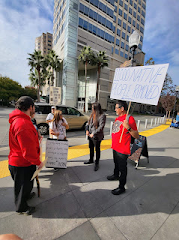
Me holding sign

I am 65 years old now, I was disenrolled when I was 49 (In fact, I got my notice on my birthday)  I AM STILL HERE.  Enterprise Rancheria, Robinson Rancheria, Grand Ronde HAVE ALL restored the rights of those they disenrolled.  THERE have been positive outcomes because THEY WORKED HARD to keep the pressure on. There are 11,000 of us, that should be plenty of weight behind our struggle.     PLEASE, honor your ancestors. 

SILENCE ISN'T GOLDEN, but akin to GIVING UP NEVER GIVE UP


Tuesday, March 1, 2022

Saginaw Chippewa's FACES of DiSENROLLMENT Real People Abused by a Corrupt Tribal Leadership

 My compatriots from the disenrolled Saginaw Chippewa have responded to my retrospective on their disenrollment and asked me to post this.  Of course I will.  Won't you share it to help?  

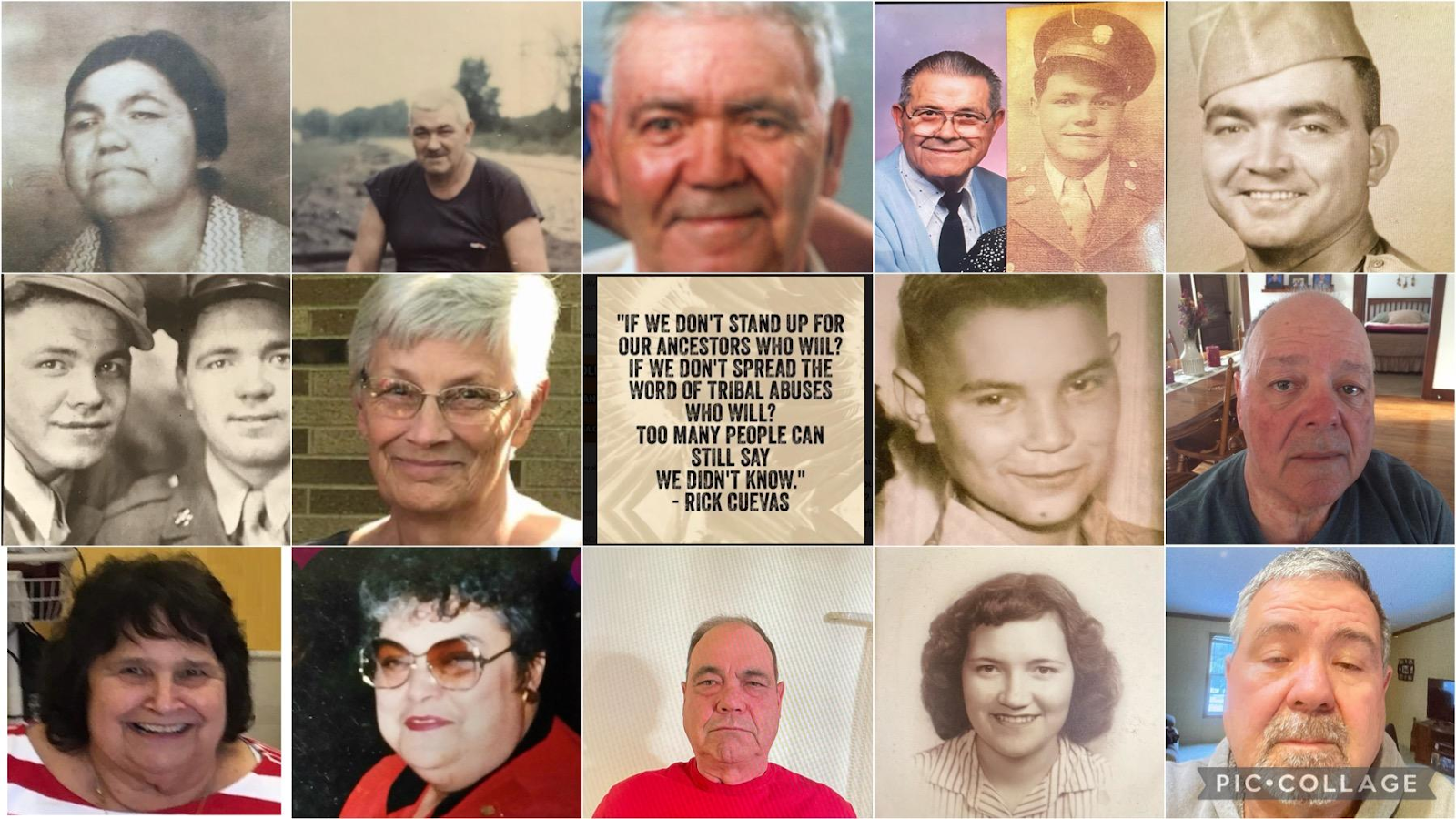
Rest in Peace Aunt Dolly Holzhausen who always supported Original Pechanga Blog on her Facebook.  If you need a picture or have what disenrollment means spelled out, HERE IT IS


THE FACES OF DISENROLLMENT
Disenrolled from the Saginaw Chippewa Tribe
of Michigan

The faces of the disenrolled, speaking more than words ever could. 

They are real people, proud people. Strong people, fighters for what is right and just, walking the path with dignity and honor. As indigenous people they follow the Grand Father’s teachings, believe that we are all interconnected, and that through tradition and culture that we gain our strength.

Friday, February 25, 2022

Tribal Disenrollment Restrospective: The Enterprise Rancheria Disenrolled Members for Speaking OUT. Who Needs 1st Amendment Rights. Eighth in the Series


Here's a story of the ENTERPRISE RANCHERIA who disenrolled over 70 members in 2003, please take a look.  Oh, and there is an update at the end

Please keep in mind, the numbers may look small but they equate to a significant population of a tribe.   For instance, the Picayune Disenrollment would equate to 16,000,000 Californians being eliminated as state citizens, with no rights to vote, or any state services.   Enterprise Rancheria disenrollments would equate to over 4,000,000 California citizens being denied their rights.  

Thirty former members of Enterprise Rancheria protested in front of the tribal office Saturday, while one disenrolled member waited for an appeals hearing at the Palermo Grange.

In November 2003, the Enterprise Rancheria booted 70 tribal members who questioned the way the tribal council spent a human services fund, according to Robert Edwards, a disenrolled member. Later two more tribal members were disenrolled.

Tribal Disenrollment Retrospective Series: Pala Band of Luiseno Indians Disenrolls 154, Nearly 17% of the Tribe Seventh is the Series

 Margarita Brittain

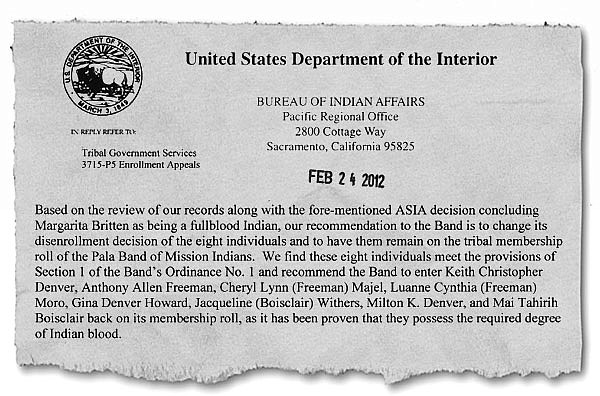
February 2012 brought more bad news from California's Indian Casino Country.  The disenrollment of 154 citizens of the Pala Band of Luiseno Indians, with some subterfuge from the current chairman Robert Smith.  He had Margarita Brittain's blood quantum changed. THE BIA stepped into the membership dispute

On the official 1913 Pala enrollment documents, Margarita Brittain is listed as a full-blood CupeƱo Indian. In the 1970s, however, it was discovered that someone had gone into the document, circled Brittain’s blood degree, and in ink changed her blood quantum to ½ and her children’s to 1/4. Her descendants speculate that the change was made out of spite, because Margarita Brittain had married a white man and taken his name.

BACKSTORY

Thursday, February 24, 2022

Tribal Disenrollment Retrospective Cahto Tribe of the Laytonville Rancheria, OUT, Then Back In, Then OUT Again Sixth in the Series

 “As far as we’re concerned, we would rather not be involved in enrollment issues,”  “But if an issue comes up, we have to comply with their laws.”
Dale Risling  - Bureau of Indian Affairs

Cahto Tribe's 
Gene Sloan

Gene and Alice Sloan have been fighting for their rights for 25 years.  After wrongdoing was discovered, former tribal chairman Gene Sloan was disenrolled.  Their crime?  Exposing the criminal activity

For years, tribes in California and across the country have been kicking out members – sometimes over objections that those being “disenrolled” have legitimate claims to being part of the tribe. In most cases, the federal government can do nothing, and hasn’t tried.

That’s what makes the Sept. 22 federal district court ruling against the Cahto Tribe of the Laytonville Rancheria so unusual. The appeals court ruling essentially told the tribe to let 22 members back in, or risk losing most federal benefits. The tribe has 60 days from the ruling to file an appeal.

Tribal Disenrollment Retrospective: Saginaw Chippewa Disgraces Grandma Grace Fowler and Descendants Fifth in the Series

 You'd think a tribe like Saginaw Chippewa, that were victim of JACK ABRAMOFF would stick together.  But, alas, no

Grandma Grace Fowler

In 2009 the Fowler family was DISMISSED with PREJUDICE in their second dis-enrollment hearing only to be over turned by the Tribes appellate court in 2014. It was overturned 5 years after the case was dismissed because the Tribal Council made a resolution to their Ordinance #14 allowing them to re-open previous cases. The Tribal attorney's called it an administrative action to correct procedural issues, the paid for by the Tribe appellate court judges ruled they could reopen the cases. This family has been up for dis-enrollment three times, discriminated against by corrupt non- natives!!

The family was dis-enrolled in 2016

The Saginaw Chippewa Tribe has proceeded with Disenrollments and has changed it's Ordinance #14 to continue to exclude members of the Tribe. 

These changes include a " No statue of limitations" on membership dis-enrollment, meaning no one is safe, EVER, NO ONE!!! 

The Saginaw Chippewa Tribe also has the distinction of being one of only two tribes in the Unites states that disenroll deceased members. A disgrace to our ancestors and not the way of the true Saginaw Ojibwe Anishinabek!

Get involved, be informed, let your voices be heard. RISE UP AND FIGHT!

I am linking here to a column from Saginaw Chippewa disenrollee William Masterson  please read and learn more.  An excerpt:

Seven generations ago my paternal and maternal grandfathers, of whom I am a direct lineal descendant, signed the 1855 treaty that was used to establish Saginaw Chippewa tribal lands, yet I was recently notified of my disenrollment. 

I ask again, how can this be? The newly elected Tribal Council can correct the deficiencies in the way in which membership is determined, but they need to hear it from the community. 

Tell them you do not want a system in which some members can be picked and chosen for membership by Council motion while others in the exact same circumstance are disenrolled. 

Tell them you do not want leaders that prefer taking the easy path rather than providing true leadership. Tell them you do not want leaders that shun their responsibilities solely based on what is good for them politically. Tell them you want leadership that addresses issues based on honest and truthful assessments of the facts before them.

OP: Some current members in control can't seem to be traced to.the 1982 BASE ROLL yet disenroll others.  That's a pattern we have seen in other disenrollments.  Equal justice is denied

Read what disenrolled member JUDY POTTER related about disenrollment before she passed.


MORE ON SAGINAW CHIPPEWA Disenrollment:


Saginaw Chippewa Seeks Investigation over Recognition
Saginaw Chippewa JUDGES say Tribe CAN Ruin lives...
Disenroll Saginaw Chippewa to SAVE MONEY
Disrespecting the Saginaw Chippewa Ancestors
Spineless BIA is MIA in Michigan

Tribal Disenrollment Retrospective: Robinson Rancheria Corrupt Chairman Tracey Avila Leads Disenrollment. Fourth in a Series


Tribal disenrollment can happen for many reasons, but two are prominent  GREED and POWER.  That's the keys at Robinson Rancheria, Tracey Avila  corrupt, embezzler is the perfect example of that.  There is Good NEWS at the end of the story, however, please read and share.

TRIBAL DISENROLLMENT: Robinson Rancheria Moves Forward with Disenrollments

ROBINSON RANCHERIA – Lake County News

Late last week, certified letters that dozens of Robinson Rancheria Band of Pomo tribal members were dreading began to arrive.
Sent out to several dozen Pomo, the envelopes contained resolutions for each person, passed in a 3-0 vote held by the Robinson Rancheria Citizens Business Council on Dec. 5, informing them that they had been disenrolled from the tribe and their names removed from its rolls.
The resolutions were signed by Tribal Chair Tracey Avila and Secretary-Treasurer Kim Fernandez on Dec. 10.
Avila had previously told Lake County News that 60 of Robinson's 347 tribal members had been under consideration for disenrollment.
On Tuesday, she said six people had proved their lineage and so were allowed to retain their tribal membership, while several more had asked for special consideration to be able to secure documents proving their lineal descent from tribal members on the tribe's original rolls.
EJ Crandell, who was elected tribal chair in June in an election that was decertified by the tribe's election committee, has asserted that as many as 74 tribal members faced disenrollment, and supplied Lake County News with a list of about 50 names of people who he said had confirmed receiving the disenrollment resolution.
Crandell's wife's family was among those disenrolled. He said he's concerned that he and his immediate family may be next.

Tribal Disenrollment Retrospective: Redding Rancheria Expulsion of Virginia Timmons Descendants and Bob Foreman, their FIRST CHAIRMAN After Restoration Third in a Series

Redding Rancheria Shames
Indian Country

We continue our series reminding all of the early beginnings of Tribal Disenrollment. Tribal disenrollment is afflicting over 11,000 Native Americans. That would make the disenrolled on of the largest tribes on the west coast, but now it leaves them culturally homeless and without a tribe.  Bob Foreman of the Redding Rancheria brought health care for Indians in N. California.  He was elected the first chairman after restoration.  The despicable Barbara Hayward Murphy and Tracy Edwards led the disenrollment. Read the shameful story and share.  Consider BOYCOTTING the Win River Casino until the restore the Foremans to their rightful place.

 
Complete article from the Times of Los Angeles of this complete act of abuse of tribal sovereignty

The late Virginia Timmons was among the 17 Indians still living on the Redding Rancheria when it was disbanded by federal order in 1959, one of the sad milestones of the Indian experience in California.

Her daughter, Lorena, was among the 130 original members enrolled in the tribal group after its reestablishment 24 years later, a restoration that came about partly through the efforts of her grandson, Bob Foreman.

To this day, many of Virginia Timmons’ 75 descendants remember her as the cheerful woman they called “Nano.” She loved the music of Elvis and used to startle guests by uttering phrases from a near-forgotten tribal language in her sleep. Many of her offspring have served the rancheria as members of the tribal council, executives of its health clinic, administrators of its educational programs or managers of its thriving Win-River casino.

By almost any measure, Timmons’ family would have to be ranked among the leading clans of the Redding Rancheria, which sits on 30 acres of land in the shadow of Mt. Shasta. So one can only imagine their dismay at the movement to kick them all out of the tribal organization.

Our history’s always been here,” says Carla Maslin, one of Virginia Timmons’ great-granddaughters. “I think it’s a crime when people start trying to take others’ heritage away.”

Maslin’s father, Bob Foreman -- the same man who was instrumental in reestablishing the tribe -- is more succinct. “It’s greed,” he says. “Out and out, that’s what it is.”

Foreman, now 67, is alluding to the feature of tribal life that hangs over the so-called disenrollment case like a shroud: the disbursement of roughly $3,000 that every tribal member receives from the casino each month. Disenrolling the family, which could cut the size of the tribe to about 186 members from 261, could consequently mean an increase of about 40%, or $1,200, in every remaining member’s monthly take.

“This proves the truth of an old Chinese aphorism, ‘You never really know someone until you share an inheritance with them,’ ” says the family’s Las Vegas-based lawyer, Michael V. Stuhff.

Tribal representatives say the case is not about money, but about the tribe’s legitimate interest in establishing its own identity under conditions in which there just happens to be money at stake. “If the Foremans have produced any evidence other than the circumstances to suggest this is about money, I’d like to know what it is,” says David Rapport, the tribe’s outside lawyer.

It’s unclear whether the Redding situation is a harbinger of more such conflicts over tribal membership. Only a handful of disenrollment cases have arisen in California in recent years, including a Pechanga reservation case that reportedly has been dropped. “The incidence rate in California is pretty amazingly low,” says Michael Pfeffer, executive director of Oakland-based California Indian Legal Services, an independent agency providing a neutral hearing officer in the Redding case.

Still, it’s only now becoming widely appreciated how burgeoning casino wealth means that tribal membership might confer not merely cultural identity but substantial financial reward too.

The challenge to the Foreman family dates to June 2002, when the tribal council received two letters alleging that Virginia Timmons bore no children. The letters, which were written by an elderly tribal member named Dorothy Dominguez shortly before her death, implicitly attacked the bona fides not only of Timmons’ only child, Lorena (who was born in 1916 and died in 1995), but of Lorena’s five children, their 17 offspring and the two generations that have followed.

The family contends that Dominguez, who they openly deride as an aged, bitter alcoholic, could not have had any grounds to challenge Lorena’s parentage. Among other things, they say that Dominguez was 16 years younger than Lorena and therefore not in any position to know the circumstances of her birth. They contend the 10-member tribal council -- which currently includes three Foreman family members -- should have rejected the allegation out of hand.

Instead, an enrollment committee examined Lorena’s file and determined that it included neither a birth nor a baptismal certificate. The panel asked the family to provide such documentation, even though it would have been highly unusual for an Indian born in 1916 to have had a formal birth certificate.

The Foremans delved deep into dusty family and public archives. They turned up federal Indian records, census rolls and other contemporary references establishing Lorena’s lineage. They offered up pages from the Foreman family Bible recording births and deaths, all of this from a period in which there could be no conceivable gain, financial or otherwise, from fabricating such a familial relationship. They even exhumed Virginia Timmons’ body, obtaining a bone sample for a DNA test that established a statistically likely maternal link between Timmons and one of Lorena’s living children.

Despite this mountain of evidence, the tribe has continued to press the disenrollment case, raising the family’s suspicions about its motives. The Foremans believe the chief threat to its standing, however, is not the question of documentation, but the quasi-judicial procedures the tribe has established in the matter. These include a merging of an evidentiary hearing before the tribal council with a general vote on the disenrollment by a secret ballot of all adult tribal members present later this month.

With the hearing and the balloting combined, the family fears they are being set up to lose a massively self-interested vote. Their concern is intensified by the tribe’s plan to bar the Foremans from voting, on the grounds that they have a direct financial interest in the outcome.

2004 Flashback on Tribal Disenrollment Protests GROUND ZERO Begins in Sacramento During Schwarzenegger Administration Part Two in A Series


Tribal disenrollments started making national news in 2004.  To understand what's happening now with the Nooksack 306 eviction issue, it's good to get the history of the disenrollment struggles.  Redding Rancheria had disenrolled the Lorena Butler descendants and their first tribal chairman Bob Foreman. Pechanga had disenrolled the Manuela Miranda descendants, over 130 adults.

From James May in Indian Country Today 

Several hundred disenrolled members of various California tribes staged a lengthy and loud protest on the steps of the state capitol asking Gov. Arnold Schwarzenegger and the state legislature to immediately halt signing new compacts with the state's tribes as a first step toward creating an inter-tribal appeals process for disenrollees. (OP: Money over morality won Ahnuld was worthless)

At least nine tribes were represented at the July 14 demonstration and are
perhaps a testament to a growing controversy in which increasing numbers of
the state's tribes are finding themselves left without tribal membership.

The tribes at the protest represented a fairly balanced geographical cross
section of the state and have formed an organization called California
Indians for Justice. Organizers said this demonstration represents the
first step that the group plans to take and claim that they will
demonstrate at various tribal casinos as well as the U.S. Congress in
Washington, D.C.

Though questions of Indian policy and issues are usually handled by the
federal government, organizer Laura Wass, who works with the Fresno chapter
of the American Indian Movement, felt it was important to start in
California.

READ the full article at the link above, and share on your social media.


Tribal Disenrollment Review of Picayune Rancheria of Chukchansi Indians Disenrollment. Looking Beneath The Gaming Glitter One in a Series


Most Egregious Disenrolling Tribe

As our Nooksack 306 relations are bringing much needed media attention to their tribal disenrollment and forced evictions, my editorial board* thought it important to bring some reviews of the histories of disenrollment.  The most egregious, the Picayune Rancheria of Chukchansi Indians, which is in Coarsegold, CA  north of Fresno which has destroyed the heritage of nearly HALF of their tribe.

The Fresno Bee had been on top of the corruption at Chukchansi for over a DECADE when we posted this story from 2008.  The corruption is staggering.  The civil and human rights violations that the BIA, the State of California, and the local county governments are still ignoring are STAGGERING.   PLEASE read and share on twitter and Facebook.   

Read the horrors from this 2003 Fresno Bee article

The biggest, most expensive and most controversial American Indian casino/entertainment complex in central San Joaquin Valley history is expected to make its debut in eastern Madera County in 10 days.

With it comes a long-simmering and increasingly bitter tribal civil war over who will pocket the profits of a business that eventually could rake in $200 million or more a year.

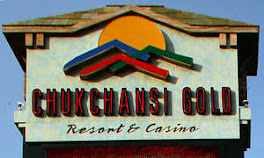
Carved out of a once-forlorn swath of rocks and brush in the Sierra Nevada foothills near Coarsegold, the gamblers' half of the Chukchansi Gold Resort & Casino is all but finished.

That's the casino, home to 1,800 slot machines and more than 40 card tables. June 25 is the planned opening date, according to the owners, the Chukchansi Indians of Picayune Rancheria.

The 192-room hotel is expected to open next door in August. The total project's estimated cost: $150 million.

Indian gaming has been a fixture in the six-county central San Joaquin Valley for two decades. Gamblers, though, have seen nothing locally like the Chukchansi digs -- nearly 300,000 square feet of casino, hotel and entertainment venues.

Nor has there been anything here quite like the Chukchansi membership fight that has brewed for four years.
Its roots go back even further. Twenty years ago, the tribe had only 30 members, the result of federal policy dating back to the Eisenhower administration designed to terminate Indian lands such as rancherias. The thinking, at least among non-Indians, was that Indians should be assimilated into mainstream America.

It took several decades of court battles, but many tribes finally regained their legal recognition and the right to renew their lives on rancherias. In a word, they were "reconstituted."

By the late 1990s, with the Chukchansi tribe legally reborn, a liberal enrollment policy raised the membership total to more than 1,000.
Then, in 1999, as negotiations with a casino management company neared a critical juncture, nearly 200 people were suddenly kicked out of the tribe.

Membership fights are nothing new among casino-owning tribes. For example, Table Mountain Rancheria in Fresno County has been the center of a long struggle among four extended families of Mono-Chukchansi Indians who own Table Mountain Casino and several hundred Indians who say they have been illegally excluded since the tribe was reborn in the early 1980s.

The Chukchansi battle, though, is different. This doesn't involve people on the outside who want in. These are Indians who were full-fledged tribal members one day and the next day found themselves out in the cold for what they say is no good reason.

Please follow the series

* Editorial board is Me, Myself and I

Saturday, February 12, 2022

Native American Rights Fund Shows It's WARRIOR SPIRIT On Tribal Disenrollment

 This week, I called out NARF on it's Valentine's Day Fundraising effort in this post

I Call on All 11,000 Disenrolled Native Americans to GIVE NARF What they Deserve: ZERO Hard Earned DOLLARS

Guaranteed to Remain Blissfully
Ignorant on Disenrollment

Looks like they're mad at being exposed as not giving a shit about 11,000 of us who have been harmed by their tribes.   No support for us EVER, yet they ask for donations to help with JUSTICE   

Thursday, February 3, 2022

Tribal Disenrollment Is CRUEL and UNUSUAL PUNISHMENT For Disagreement and Political Opposition


The author Julia Stinson, here is talking about tribal disenrollment due to criminal activity.  But in our case at Pechanga, we had criminals working to disenroll us.   If it's cruel and unusual to disenroll for a crime, isn't it even MORE cruel to disenroll over disagreements, or political opposition?


Tuesday, January 25, 2022

Cam Foreman: HUMAN RIGHTS ABUSES IN INDIAN COUNTRY by...INDIANS


My friend Cam Foreman, a Lorena Butler descendant from the Redding Rancheria has a terrific op/ed published by the estimable Indianz.com which has consistently gotten the issue of tribal disenrollment out front.  I'm happy to say I've been quoted an published there as well.

 
The following is the text of a letter sent to Secretary of the Interior Deb Haaland, Assistant Secretary for Indian Affairs Bryan Newland, National Congress of American Indians President Fawn Sharp, and members of the Senate Committee on Indian Affairs and the House Subcommittee for Indigenous Peoples of the United States.

We are at a crossroads in United States and Indigenous history.

Tuesday, January 18, 2022

If We Don't PUSH ADVOCACY Groups Like NCAI and NARF to Help Wrongfully Disenrolled WHO WILL?


Stop Disenrollment
by SPEAKING OUT

I write this blog on behalf of all disenrolled Native Americans.  Fawn Sharp of the National Congress of American Indians WON'T.  Neither did her predecessor Brian Cladoosby.  They are okay with letting 11,000 Native Americans roam the wilderness, without a tribe.

We can't even get our first Native American Secretary of the Interior Deb Haaland to do more than give lip service.  She may care, or sympathize with our ancestors abuse, but she hasn't been strong, vocally.  The disenrolled are sacrificed at the altar of sovereignty.

I'm POSITIVE that I am doing the right thing, as I'm speaking for the thousands of Native Americans that have been harmed by negative speech, including baseless claims against their ancestors. their elders and historical documents.

As I asked Congress staffers of my own two Senator's, when I lived in California, if YOU won't look out for us, who will?

I am shining a spotlight on the corruption of some tribes and organizations who are using sovereignty as a club, to beat the weak and helpless, including elders and children.  I allow others to guest blog to get both their issues and those topics that will benefit all of us to more people.  

NCAI and Fawn Sharp won't help, even in the smallest amount, which would include speaking out against the tribal leaders who are harming ..ACTUALLY harming Native Americans, rather than using a nickname they don't like (that is a racist one) and mascotry. 

Native American Rights Fund won't do "Indian vs. Indian" and have had on their board, a tribal chairman that runs an apartheid reservation, one who overturned the will of the people by refusing to follow the law and customs.

I do this blog, so that it may NOT BE SAID, "I didn't know".  If all who read this share my posts on their social media, there can be a learning, an enlightening.   

DIRTY LAUNDRY needs to be aired.  We can't be silent and HOPE the issue fades.  We must be active, as that is the only way to combat the deep pockets and political friendships that tribal money creates. 

The elected leaders, both tribal and federal, respect money more than rights.  The only way to change that, is to add YOUR voice, to expose the corruption